Tinnitus Treatment in Chambersburg, PA
Ringing, buzzing, hissing or humming that nobody else can hear. Tinnitus treatment in Chambersburg, PA starts with understanding one thing: what you're hearing is real, it's common, and it is almost always a signal about something else in your hearing system rather than a condition on its own.
That last part is why an appointment here starts with a hearing evaluation instead of a product. Tinnitus is a symptom. Finding out what's driving it is what determines whether anything can be done about it — and in a meaningful number of cases, something can.
Some tinnitus needs a doctor first, not a hearing aid
Most tinnitus isn't dangerous. A few presentations are different, and these warrant prompt medical attention rather than waiting for a hearing appointment:
- Tinnitus in only one ear
- Tinnitus that pulses in time with your heartbeat
- Hearing loss that came on suddenly, over hours or a day
- Tinnitus with dizziness, vertigo or loss of balance
- Tinnitus alongside facial weakness, numbness or severe headache
If any of these describe you, contact your physician or an ENT promptly. Sudden hearing loss in particular is time-sensitive and treated more successfully the sooner it's seen. Call us as well — we can often get you tested quickly and send results along — but don't let an appointment with us delay a medical evaluation.
Why the ringing starts
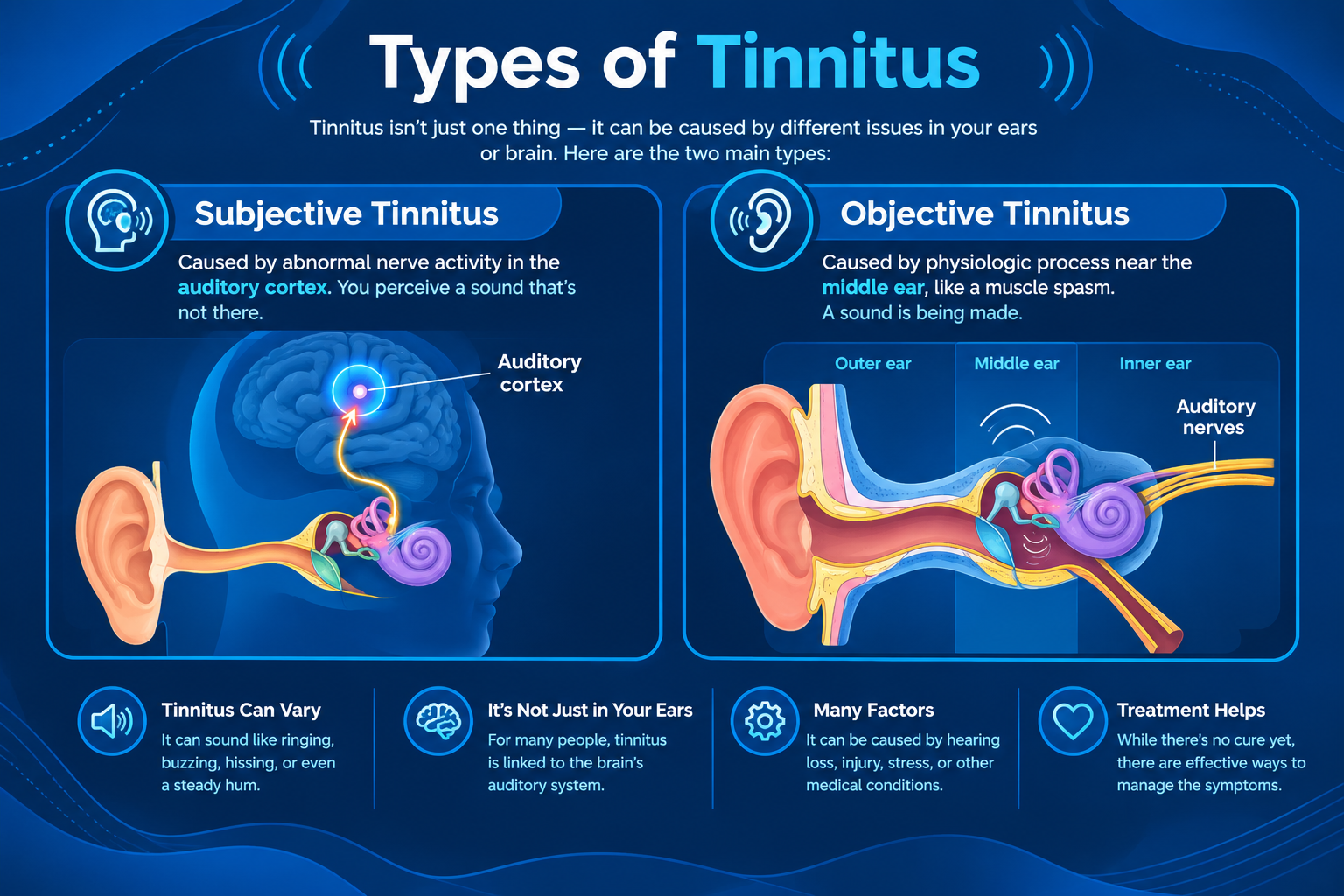
The usual sequence goes like this. Hearing fades quietly over years, typically in the high frequencies first, and typically without anyone noticing. The brain stops receiving input in that range and appears to compensate by increasing its own internal activity. What you perceive as ringing is that compensation.
This is why so many people who arrive certain their hearing is fine leave with an audiogram showing otherwise, and why the tinnitus often shows up before the hearing loss becomes obvious in conversation. It's also the reason measurement comes before recommendations here.
What's actually causing it
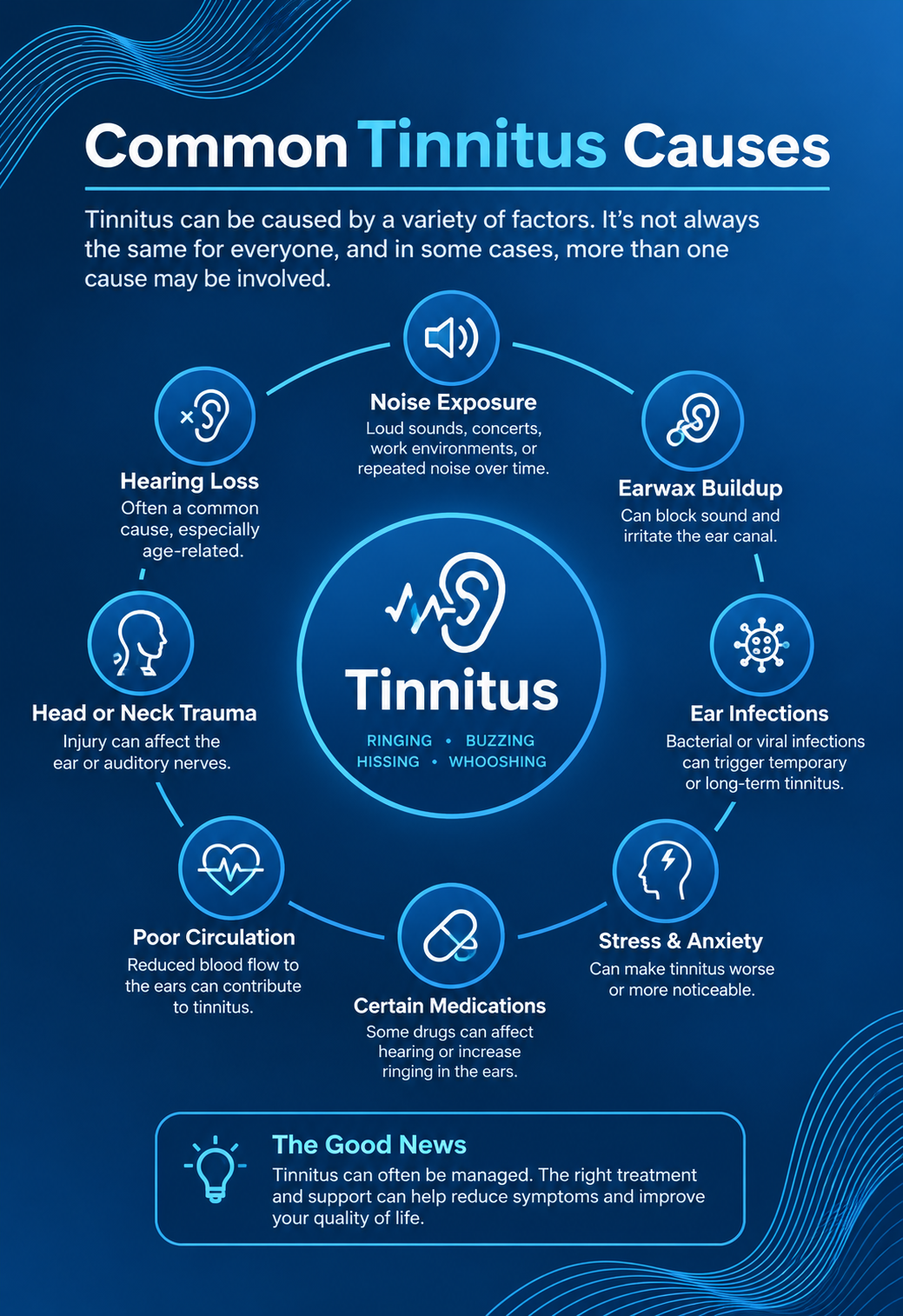
Tinnitus has many possible drivers, and more than one can be at work at once. These are the ones we see most often in Franklin County.
By far the most common association. When the ear stops delivering certain frequencies, the brain generates activity of its own to fill the gap. Treating the hearing loss is what most often reduces the tinnitus.
Years on a job site, in a shop, on a tractor, or at the range. Noise damage and tinnitus travel together, and the tinnitus frequently arrives before anyone notices the hearing loss behind it.
Sometimes the answer really is simple. Impacted wax, fluid, or a middle ear problem can produce tinnitus, and clearing it can resolve it. We check for this before assuming anything more complicated.
Some medications list tinnitus as a side effect, and blood pressure, thyroid function, TMJ problems and neck injuries can all contribute. Never stop a prescribed medication on your own — bring the list to your physician.
What a tinnitus evaluation involves
The point is to separate what can be treated from what needs to be managed — and you can't do that without measuring.
Your history
When it started, what it sounds like, when it's worst, what you've already tried, and what it's costing you in sleep and concentration.
Ear examination
A look at the ear canal and eardrum to rule out wax, fluid and other physical causes before anything else is considered.
Comprehensive hearing test
A full hearing evaluation, because hearing loss is the most common driver and frequently the one you didn't know you had.
A plan you understand
What we found, what's likely behind it, the realistic options, and what to expect from each — including when the answer is a referral.
What we can honestly promise
There is no pill, supplement or device that reliably eliminates chronic tinnitus, and anyone selling you one is selling you something. We're not going to tell you otherwise to get you in the door.
What is true is that tinnitus can very often be made substantially less intrusive. For most people the goal isn't silence. It's getting the tinnitus from something that dominates your evenings to something you notice occasionally and then stop thinking about — and that is an achievable goal for a lot of patients.
The most reliable route there, when hearing loss is present, is treating the hearing loss properly. That's not a sales line. Amplification restores the input the brain has been missing, and it brings back the ordinary background sound that keeps tinnitus from standing out in a quiet room. Which is also why we verify every fitting with real-ear measurement — a device that was never measured can't do that job properly.
Approaches that help
Which of these fits depends entirely on what your evaluation shows. Most patients end up using more than one.
Treating the hearing loss
When tinnitus comes with hearing loss, properly fitted hearing aids are the single most effective step for most people, and the effect is often noticeable within the first few weeks of consistent wear.
Sound therapy
Most current hearing aids include tinnitus sound generators — soft tones or shaped noise played at a level that makes the tinnitus less prominent without masking conversation. We program and adjust these as part of the fitting.
Cognitive behavioral therapy
CBT doesn't change the sound; it changes the distress attached to it, and it has the strongest research support of any tinnitus intervention. For patients whose tinnitus is affecting sleep or mood, we'll help you find a referral.
Sleep and quiet-room strategies
Tinnitus is loudest where there's nothing else to hear. A fan, a sound machine or low background audio at bedtime is unglamorous and genuinely helps — we'll go through what works.
We don't sell tinnitus supplements, and we'd encourage you to be skeptical of anyone who does. The American Academy of Otolaryngology clinical practice guideline advises against routine use of dietary supplements or medication for persistent tinnitus, because the evidence isn't there.
Common questions about tinnitus
Is there a cure for tinnitus?
Not for most chronic tinnitus, and you should be wary of anyone claiming otherwise. Where tinnitus has a specific reversible cause — impacted earwax, a middle ear infection, a medication side effect — resolving that cause can resolve the tinnitus. For the more common kind linked to hearing loss, the realistic goal is reducing how intrusive it is, which is achievable for a great many people.
Do hearing aids help tinnitus?
For patients who have hearing loss alongside their tinnitus, frequently yes, and it's usually the most effective single step available. Two things happen at once: the brain gets back the sound input it was missing, and the everyday background noise that had gone quiet returns, so the tinnitus no longer stands alone in the silence. Most modern hearing aids also include dedicated tinnitus sound therapy programs.
Why is my tinnitus worse at night?
Because there's less competing sound. Tinnitus doesn't usually get louder in the evening — the room gets quieter, so it takes up more of your attention. Stress and fatigue amplify that effect. Low background sound at bedtime is the standard first response and helps most people.
Should I worry about tinnitus in only one ear?
One-sided tinnitus is worth having looked at promptly. So is tinnitus that pulses with your heartbeat, tinnitus with sudden hearing loss, and tinnitus accompanied by dizziness. None of these necessarily mean something is seriously wrong, but they warrant medical evaluation rather than watchful waiting. Contact your physician, and call us as well so we can get you tested.
Will tinnitus cause me to go deaf?
Tinnitus itself doesn't damage hearing. But because it so often accompanies hearing loss, tinnitus is a reasonable prompt to get your hearing tested — many people discover a loss they hadn't noticed. Getting a baseline measurement matters more than the tinnitus itself.
Do tinnitus supplements work?
The evidence doesn't support them, and clinical guidelines advise against routine use of supplements or medication for tinnitus. We don't sell them. If a product promises to cure tinnitus, that promise is the reason to walk away.
What does a tinnitus appointment cost?
Call us and we'll be straight with you about the cost of an evaluation and what your insurance covers. Christine verifies benefits before your appointment so there aren't surprises.
Further reading:
National Institute on Deafness and Other Communication Disorders ·
American Tinnitus Association ·
AAO-HNS Clinical Practice Guideline: Tinnitus
This page is general information, not medical advice. Speak with a qualified
professional about your own situation.
Let's find out what's behind it
Tinnitus care starts with a comprehensive hearing test. Call us or request an appointment, and Christine will confirm your benefits beforehand.
Request an Appointment (717) 504-8459